Startup Elevator Pitch Coach - Matt Boardman

Startup Elevator Pitch Coach
  • English
  • Español
  • English
  • Español

Matt Boardman - Startups and the Elevator Pitch

My blog gives you tips on how to succeed: in your elevator pitch, networking and daily prioritisation.

  • About me
  • Methodology
  • Services
  • Blog
  • Contact me
  • All
  • Elevator pitch
  • Focus
  • Influence
  • Networking
  • Presentations
  • Public speaking
  • Sales
  • Startups

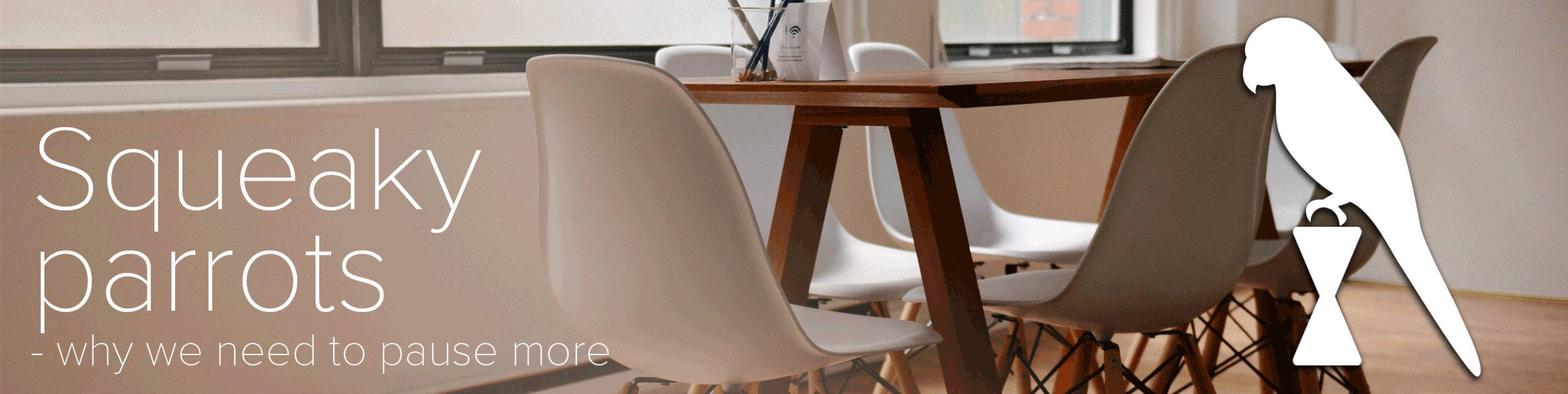
Squeaky parrots - why we need to pause more

Matt Boardman March 10, 2015

How often, in a conversation of more than two people, have you felt you had to jump in as quickly as possible to make yourself heard? In this post I'm going to show you why a squeaky novelty parrot is what you need to get more out of every single group discussion from now on.

If you read last week’s post on smiling, you’ll know that after a recent move to Madrid I have found my Spanish is, while sufficient for general conversation, hindering my ability to connect with people on the same level as I can in English. This has recently proved to be particularly true in group conversations, and in a way that has made me realise how often I have unintentionally made it hard for other people to contribute.

This week I attended two workshops run by the phenomenal organisation tejeRedes, who help organisations fine-tune their awareness of what it means to interact consciously in a team (partly with the inventive use of orange thread!).

At work with tejeRedes in the mildly crypt-like but excellent venue La Tortuga in Lavapies, Madrid.

At work with tejeRedes in the mildly crypt-like but excellent venue La Tortuga in Lavapies, Madrid.

Lacking fluency in a group social situation like a workshop has made me appreciate two things:

  1. How much effort it takes to properly listen to the previous speaker
  2. The tiny amount of time we leave after one speaker before another begins drastically reduces the ability of participants who need longer to think (whether because of language difficulties or a preference for longer reflection)

Spanish friends have told me, with a vaguely mischievous sense of pride, that it can be difficult to interject here because interrupting is much more common than in Britain. But I think it’s more than that. The problem is one I have seen in London as many times as in Madrid.

The problem

During a frenetic discussion about democracy in traditional organisations, I suddenly remembered Susan Cain’s words: “Our most important institutions, our schools and our workplaces, they are designed mostly for extroverts”. I’m not suggesting that introverts are in any way akin to people struggling with a foreign language. What I am suggesting is that, because I needed longer to plan my next contribution than usual, a group conversation in Spanish threw into sharp relief why fast-paced group discussion can be a tar pit for introverts. In Honey and Mumford’s theory of learning styles, it is good practice when designing any training course to include activities which allow for a few moments of reflection. This can be as simple as giving everyone 30 seconds to write their ideas on a post-it note, but it greatly increases contributions from ‘reflectors’ (who are often also, but not always, introverts) who prefer to fully consider the issue before speaking. In any group discussion, in a workshop, at a networking event or at a dinner party, how much time do we usually allow for everyone to think before we start talking?

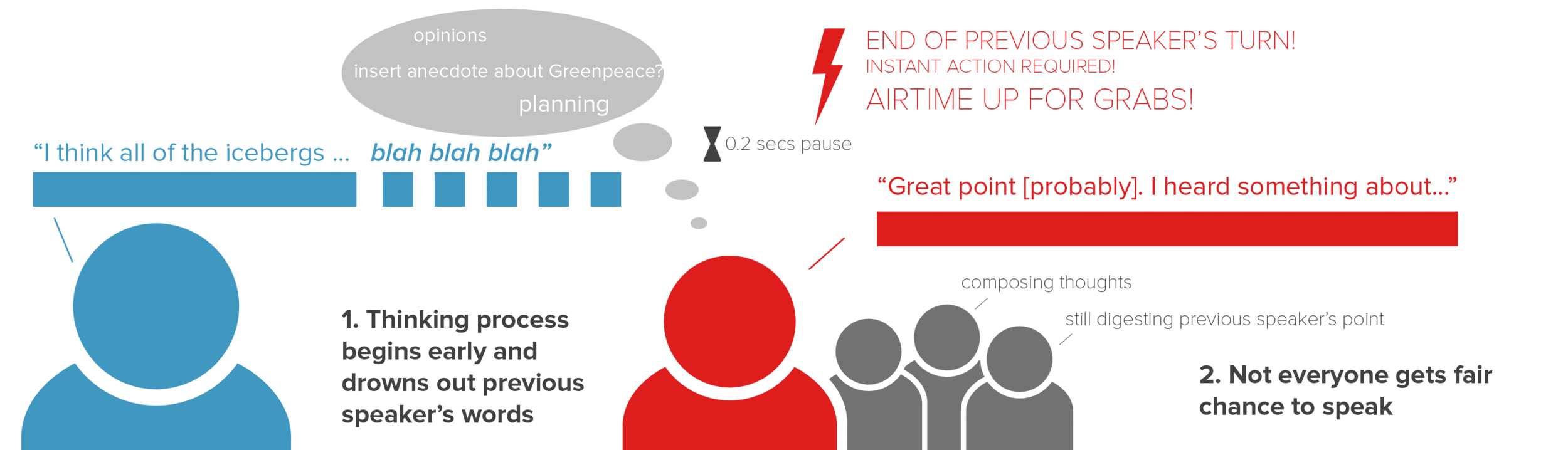
Extroverts are particularly guilty of making the faulty assumption that because they have their next contribution ready within 0.2 seconds of the end of the previous speaker’s sentence, so does everyone else. Based on this assumption, even a minuscule pause allows everyone a level playing field to contribute. It doesn’t.

The second consequence of our habitually tiny pauses is this: anyone who wants to compete for the 0.2 second window of opportunity must have started thinking about their contribution during the previous speaker’s. It doesn’t take a social scientist of world renown to work out that this makes us much less able to digest what the previous speaker is saying.
squeaky1

So what’s the solution?

During one hectic workshop debate our facilitator Cristian introduced, like a toyshop deus ex machina, a squeaky novelty parrot. The rule, as aficionados of conch-based infantile mediation will know, is that only the person holding the parrot is allowed to speak.

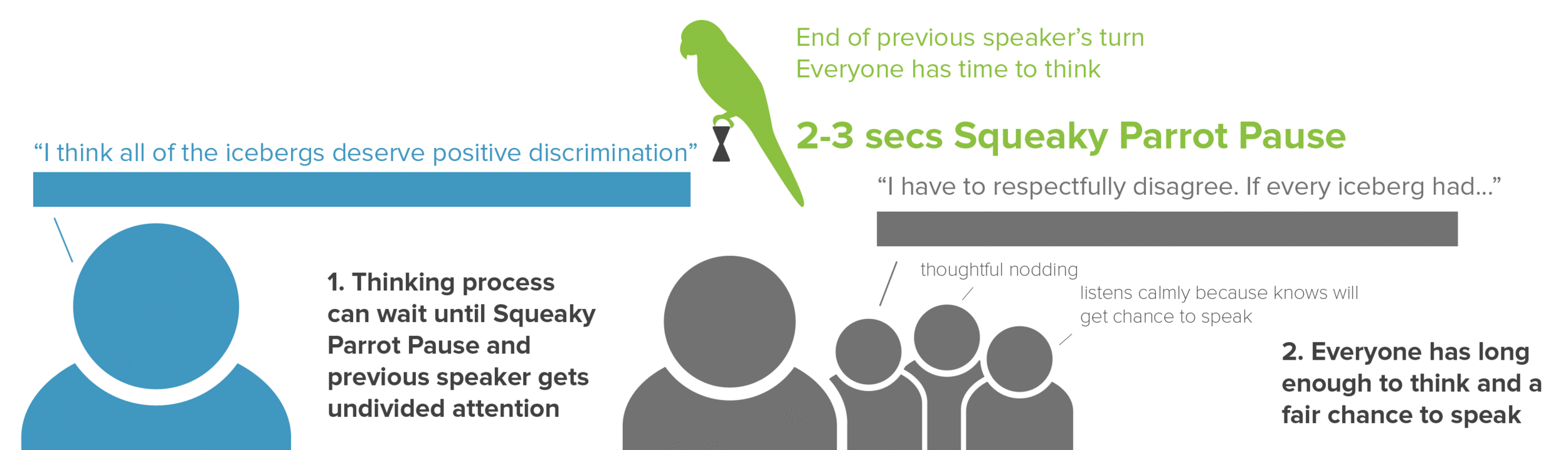
The parrot provided helpful visual emphasis of the importance of turn-taking in human interaction. But for me, more important than that was the functional 2-3 pause it enforced. Each time a speaker finished, it took a few seconds for them to look around the room to the next person wanting to speak and pass them (often with unwittingly dangerous velocity) the squeaky novelty parrot.
squeaky2

I am not suggesting that you should from now on bring to every group discussion a squeaky novelty parrot, as it could be inappropriate in certain situations such as black tie dinners (though it should perhaps be considered for some members of the Turkish parliament). My point is this: if we could remember to leave a habitual 2-3 second pause (scientifically proven as the average time taken to pass a squeaky novelty parrot from one person to another) after the end of each contribution, two things would happen:

  1. The previous speaker would have everyone’s undivided attention
  2. Everyone in the discussion would have long enough to digest the previous speaker’s contribution, think of their own, and have a fair chance at getting their own airtime

Next time you’re in a group conversation, try to notice how much silence is left at the end of each person’s speech.  Notice also the people in the group who aren’t speaking much. Is it because they’ve genuinely nothing to say, or is there a faint glimmer of frustration in their eyes each time they fail to get their words ready in the split-second pause?

What do you think? Please use the comments below to tell me your experience with pauses and turn-taking in group discussions.

InNetworking Tagsnetworking, business development, coaching
  • Matt Boardman - Startups and the Elevator Pitch
  • Older
  • Newer

Subscribe

Don't miss my next blog post for startups and entrepreneurs on how to succeed: in your elevator pitch, networking and daily prioritisation.

Thanks for signing up! Don't forget to comment and let me know what you think.

Matt

Featured
 Matt is a Madrid-based elevator pitch coach who has helped more than 100 startups identify their essential story and sell it to investors through a concise, exciting elevator pitch.

Matt is a Madrid-based elevator pitch coach who has helped more than 100 startups identify their essential story and sell it to investors through a concise, exciting elevator pitch.

Read more →
Matt Boardman - Startups and the Elevator Pitch RSS

See more:

Matt Boardman - Startups and the Elevator Pitch
Email, phone or WhatsApp? How to avoid common networking mistakes
February 2, 2018
Email, phone or WhatsApp? How to avoid common networking mistakes
February 2, 2018

How many emails have you received this week/day/minute? Since the dawn of email (which occurred at some point since the Bronze Age), our efficiency at work has supposedly increased. There are some contexts in which email is appropriate and more effective. But there are crucial, often-forgotten advantages of picking up the phone. If you would hate to pitch your startup by email, don’t do all your networking by it either!

Read more →
February 2, 2018
Follow up: 2 step process to get real results from networking
December 1, 2016
Follow up: 2 step process to get real results from networking
December 1, 2016

For any startup, it is often during a meeting or phone call that an investor or contact agrees to help you by completing an action: for example send you a document or introduce you to a useful contact. But because of poor memory and fading enthusiasm, a great opportunity will often be lost - unless you employ two simple techniques: follow up and chase up.

Read more →
December 1, 2016
Vocal delivery: 4 techniques to make your elevator pitch captivating (even for blind cats)
July 7, 2016
Vocal delivery: 4 techniques to make your elevator pitch captivating (even for blind cats)
July 7, 2016

If you have ever listened to a speech by someone who speaks monotonously, you will know that strong vocal delivery is vital to: 1) communicate your message clearly and 2) stop your audience going to sleep. The quickest way to make your startup elevator pitch stand out from the rest is to practise it with a simple technique: The Blind Cat Test.

Read more →
July 7, 2016
3 types of startup friend: How to pick the RIGHT advisor
June 3, 2016
3 types of startup friend: How to pick the RIGHT advisor
June 3, 2016

As any startup founder knows, you need an advisor: to listen when things go wrong, to bounce ideas off and to tell what you need to hear: even when it’s not pleasant.  But don’t make the mistake of picking the wrong friend for your startup. Do you recognise these 3 types of startup friend?

Read more →
June 3, 2016
Show your startup: 4 types of demo to make investors see, believe and invest
May 12, 2016
Show your startup: 4 types of demo to make investors see, believe and invest
May 12, 2016

When you pitch your startup to investors, you need them to understand it. The easiest way to do this is to show them your idea visually: through screenshots, a video, a prototype-as-a-prop or a live demo.

But be warned: although it is the ultimate show of authenticity, the live demo is fraught with danger. Even Steve Jobs was only a falsified phone signal bar away from disaster. 

Read more →
May 12, 2016
Run with it: Excite investors with your startup's possibilities
April 29, 2016
Run with it: Excite investors with your startup's possibilities
April 29, 2016

How do you excite an investor with your elevator pitch? It’s not enough to explain to them your startup idea. You need to show them your idea and then run with it: show them could happen with their investment. But be careful: there are two places you can run to with your idea, and only one is a place where the investor will stay excited about your startup.

Read more →
April 29, 2016
Crowd-sell your Elevator Pitch: the 5 types of social proof
February 24, 2016
Crowd-sell your Elevator Pitch: the 5 types of social proof
February 24, 2016

One influencing technique that you can use in your elevator pitch to sell your startup is social proof: the idea that we are more likely to do something if we see other people doing it first.

Read more →
February 24, 2016
Memorise your elevator pitch (without sounding like a droid)
January 7, 2016
Memorise your elevator pitch (without sounding like a droid)
January 7, 2016

Have you ever changed to the next slide in your elevator pitch, seen two long sentences and been forced to start reading them word-for-word until your brain remembers exactly what you’re trying to say?

Pitch rescue tip: You will remember your pitch, and present it more fluidly, if you memorise only 1-3 key words for each slide.

Read more →
January 7, 2016
Focus - choose when you deal with the Notification Mosquito
September 15, 2015
Focus - choose when you deal with the Notification Mosquito
September 15, 2015

Have you ever glanced at a notification on your phone and been distracted by something that you didn’t have time to deal with? This post shows why having the willpower to choose when you look at your notifications will benefit you enormously.

Read more →
September 15, 2015
Bait your elevator pitch - capture your audience with a hook
July 16, 2015
Bait your elevator pitch - capture your audience with a hook
July 16, 2015

Given that no audience enters a presentation with their minds clear from outside concerns, is your responsibility as the presenter to capture their attention. The most effective way to do this is with a “hook”, a handy technique I learnt from my time in Deloitte Consulting.

Read more →
July 16, 2015

Follow me on Twitter:

linkedin facebook

matt@matt-boardman.com      +34684363874

Startup Elevator Pitch Coach - Matt Boardman

Startup Elevator Pitch Coach

Startups cannot win investors without a strong elevator pitch. You only have 2-5 minutes to sell your startup, so don’t miss your chance. Pitch better, sell more.

Matt Boardman | Calle Marqués de Santa Ana, Madrid, Comunidad de Madrid, 28004, Spain

linkedin facebook